Construction Challenges Include Job Site Safety
Key Highlights
The survey found:
- 38% still lack a proactive approach to safety and regulatory compliance.
- 20% feel “unsure” to “not at all” confident their safety technology is supported by strong data.
- 51% of companies take mental health only “somewhat seriously” or “not at all seriously.”
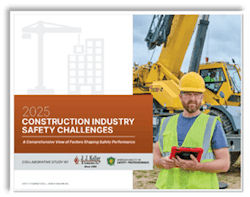
Labor shortages (38%), rising material costs (35%) and job site safety (32%) were the top three challenges to the construction industry, according to a new report, 2025 Construction Industry Safety Challenge, from American Society of Safety Professionals (ASSP) and J. J. Keller Center for Market Insights.
The report came to the following conclusions:
The Construction Industry Is Committed to Safety Amid Persistent Challenges
Safety and compliance are central priorities for many companies across the industry. However, continuing challenges are complicating progress. These span areas ranging from labor shortages to regulations, safety, training, communication and subcontractor compliance. Labor shortages (38%), rising material costs (35%) and job site safety (32%) were the top three challenges cited by respondents
Safety & Compliance Training Is Effective But Requires ModernizationWhile most respondents express confidence in the effectiveness of their current training, these programs rely largely on traditional formats. Respondents desire a future of immersive, personalized and task-specific training methods to meet their safety needs.The study found that 38% still lack a proactive approach to safety and regulatory compliance.
Advanced Safety Technologies Show Strong Potential, Although Adoption Remains Limited
Respondents are optimistic about the potential in advanced safety technologies, such as those using virtual reality (VR) and artificial intelligence (AI). Yet adoption is hindered by budget constraints, cultural resistance and integration challenges.
For now, construction companies are more likely to use basic tools than advanced innovations. The survey found that 20% feel “unsure” to “not at all” confident their safety technology is supported by strong data.
Mental Health Is Gaining Recognition as a Health & Safety Consideration
A growing number of construction companies are incorporating mental health and wellness into their safety programs, though efforts vary in depth and consistency. This signals a positive shift toward more holistic worker well-being, but wider acceptance is still strongly needed. The survey found that 51% take mental health only “somewhat seriously” or “not at all seriously.”
Ray Chishti, Senior EHS Editor. J. J. Keller & Associates, Inc.
The study identified six challenges that construction professionals must overcome in order to improve safety, health and compliance in the industry.
Navigating Evolving Regulations and Standards
Maintaining compliance with evolving OSHA and state regulations is a significant challenge, compounded by the need to interpret and apply standards across different trades and job sites.
Overcoming the Mindset of 'This Is How It’s Always Been Done'
Resistance sometimes stems from viewing safety protocols as red tape rather than essential protection.
Communicating Effectively Between Management, Supervisors and Workers
Effective communication can be hindered by language barriers, fear of speaking up, and inconsistent messages.
Managing Safety Across Multiple Subcontractors and Trades on Job Sites
Factors can include contractors not taking ownership of the safety programs and challenges in finding subcontractors who prioritize safety.
Ensuring Workers Are Well-Informed and Comprehend the Information
Construction challenges include finding the time for training and defining what constitutes adequate training.
Addressing Construction- and Trade-Specific Workplace Hazards
Examples of hazards specific to construction and trades include falls, weather, confined spaces, and exposure to hazardous materials, among many others.
“In an industry where safety risks are prominent, understanding the unique challenges faced by construction professionals is critical for creating a safer future,” added Gabriel Atencio, administrator of the construction practice specialty member community at ASSP, in a statement. “This study uncovers the current conditions in order to spark essential conversations and drive meaningful change toward a safer working environment for everyone involved.”
Read the full study which covers areas ranging from the greatest safety and compliance challenges to top unmet needs, approaches to safety performance, PPE usage, training program initiatives, advanced technology adoption, and employee mental health and wellness.