5 Ways Technology is Making Construction Sites Safer
Key Highlights
Learn what technologies you can incorporate onto your jobsite to make construction work safer for all. As an added bonus, it's likely more affordable than you think.
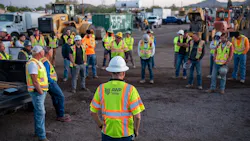
Commercial and industrial construction sites are among the most dynamic and potentially dangerous places to work. They don’t just have hazards. They also have moving systems: deliveries coming and going, forklifts and telehandlers weaving through tight spaces, subcontractors stacking work in parallel and schedules that compress decision-making. Risk comes from heavy equipment working near crews, sudden weather changes, tired workers and vehicles moving around people on foot.
Technology is giving safety professionals a way to minimize safety risks by adding visibility, speed and consistency where human attention and reflexes inevitably tap out. Many of these tools are also more deployable than people assume. Furthermore, these tools support a strong safety culture by helping teams spot risk earlier, respond faster and make protection more repeatable.
The case for investing in better tools starts with the official record. In 2024, the U.S. Bureau of Labor Statistics (BLS) reported 167,100 total recordable injury and illness cases in Construction: NAICS 23 (private industry), and an incidence rate of 2.2 total recordable cases per 100 full-time equivalent (FTE) workers. That’s the baseline burden safety leaders are managing before you even count near-misses, first aid cases or hazards that never make it into the log.
It’s still not the full picture of risk because injuries are underreported. BLS research suggests official counts can miss a significant share of cases, with estimates ranging from 33% to 69%. That’s why tools that make reporting easy, capture near-misses and speed corrective action matter; they help leaders see what’s really happening and fix issues before the next recordable injury.
Here are five ways technology is changing the game on construction sites.
1. PPE With Something to Say
The safety helmet is no longer just a hard hat, and the safety vest is no longer just reflective fabric. Modern personal protective equipment (PPE) can incorporate GPS, proximity sensing and biometric monitoring that helps to supervise worker well-being as well as detect, alert and document risk.
For example, sensor-enabled vests can warn workers when they enter a restricted zone or approach a moving asset. They can also flag when a worker has remained stationary for too long, which can suggest a fall or heat stress. In large, noisy environments where visibility is limited and radios compete with equipment noise, smart PPE offers an “extra set of eyes” that can alert workers and managers of potential harm as well as shorten response time for actual harm.
The National Institute for Occupational Safety and Health (NIOSH) flags real adoption considerations (e.g., cost, maintenance and privacy) but frames wearables as a growing, practical way to add real-time visibility and faster warnings in high-noise, limited-visibility settings where seconds matter.
Connected PPE can cost more than standard gear upfront, but the return on investment (ROI) can be realized in earlier warnings, faster checks, fewer incidents and better situational awareness, especially when it avoids even one high-severity event.
PPE should still be the last line of defense, but technology is helping make protection more proactive.
2. Cameras That Coach
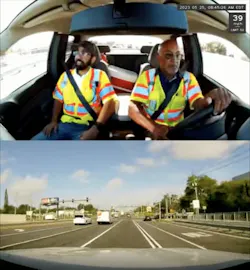
Camera systems in fleet vehicles, jobsite trucks and equipment cabs can identify risky driving behaviors, such as following too closely, rolling stops, harsh braking, distraction indicators or walking paths that repeatedly cross active travel lanes.
The true value of these cameras—beyond any immediate alerts to drivers and supervisors—is that capturing real moments offers footage can be used for coaching, targeted instruction and crew learning. When you can point out what actually happened on the jobsite rather than a hypothetical scenario, training becomes more credible and behavior change becomes more likely.
These systems can also support compliance in a practical way: monitoring access points, flagging when a vehicle enters a restricted area, or confirming zones are clear before any heavy equipment moves or high-risk lifts begin.
At AWP Safety, we’ve found the key to gaining employee buy-in is explaining how cameras are introduced and used. Recording workers is most effective when it’s treated as a measurement system, where the goal is to spot risk early, understand context and coach before a near-miss becomes an incident. When an alert triggers, the conversation shouldn’t be “You braked too hard,” but rather “What did you encounter, and what could you do earlier next time?”
Video footage also helps resolve the trust barrier that often slows adoption. In addition, telematics provides documented proof that can protect drivers—and the company—from false claims by showing the full situation, sometimes from multiple angles. Just as important, the same footage and data can be used to recognize strong worker performance, reinforcing that safety is valued.
3. Connected Cones
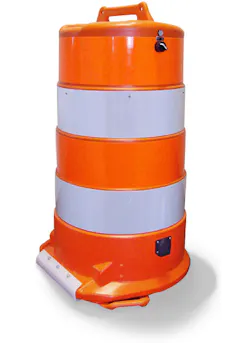
Even basic jobsite controls are becoming “smart.” Connected devices can detect when a barricade has been struck, when a device has been moved or when speeds through a controlled path are consistently higher than expected. That data can trigger alerts and support quick, corrective actions.
This is especially relevant in commercial and industrial settings where temporary paths change daily, such as delivery routes, pedestrian walkways, crane swing-radius exclusions, staging zones and access corridors. When your site layout is dynamic, static devices can quietly drift out of effectiveness. Connected monitoring can help teams catch those gaps faster.
4. Cloud-based EHS Platforms
Safety data only matters if it is used effectively. Modern cloud-based EHS platforms help teams capture and share inspections, observations, near-misses, training completion and corrective actions, which reduces the lag between what just happened and what gets fixed (and when).
The biggest advantage of cloud-based platforms is speed and consistency. Instead of waiting for paper forms to be turned in or relying on tribal knowledge, leaders can spot trends as they emerge across shifts or locations. If a handful of minor incidents point to the same exposure (i.e., hand injuries from a particular task), the system can prompt a tighter review: tool condition, glove selection, work method, targeted coaching or a quick targeted training refresher.
It also helps to standardize expectations across dispersed, field-based operations: what gets observed, how it’s categorized, what “good” looks like and how quickly issues are escalated. AWP Safety secures over 1 million work zones each year. We have found that, over time, consistency is what enables proactive prevention: spotting repeat exposures by task, location, time of day or crew type. Then, we prioritize the appropriate employee intervention(s) process changes as needed.
5. Training That Reaches the Field
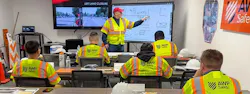
Annual classroom training has its place, especially for foundational hazard awareness and required competencies, but it rarely matches the tempo of a jobsite. That’s to say, the risks you need to reinforce today may not be the same risks you briefed last quarter. Microlearning, or short, mobile-first modules that can be delivered in minutes, helps keep safety instruction fresh and current in the flow of work.
The real advantage is timing and specificity. When weather turns, when a new subcontractor mobilizes or when the logistics shift, targeted content can be pushed immediately to the people who need it most. That microlearning material can also be paired with a quick knowledge check, so supervisors can confirm understanding without pulling crews into an hour-long session.
Like the coachable moments with telematics, these shorter lessons can improve engagement and retention, and they are most effective as targeted refreshers.
That’s the model at AWP Safety, where our training services include certified traffic training and audits that help keep content aligned with current standards, all delivered in ways that make training more accessible in the field, including smartphone friendly formats our crews can use anytime.
The Human Element
None of these technologies can replace the leadership behind a strong safety culture. Reducing risks still requires buy-in, field discipline, and a willingness to stop and reset when conditions change.
But here’s what technology is making possible: Many of these solutions can be bought, deployed and integrated without a full reinvention of your safety program. Some are low cost and quick to implement, while others require investment and change management. Either way, they give organizations greater ability to move from “We can’t control that” to “We can reduce that risk.”
And there’s a human signal embedded in this shift. When workers see their company investing in tools that reduce exposure, improve visibility and speed up response time, it reinforces a message that matters in every craft: You’re valued, and we’re focused on designing the job, so you go home safely.
Construction sites will always be busy places, but they don’t have to be unsafe.
About the Author
 Ryan Dobbins
Ryan Dobbins
Ryan Dobbins is the vice president of environmental, health and safety (EHS) at AWP Safety, a traffic control company. AWP Safety secures over 1 million work zones each year and operates through a network of regional brands spanning over 160 locations across 33 U.S. states and four Canadian provinces.