Workplace Violence Assault Trends

A topic that is very much on both employers’ and employees’ minds is the increasing violence that is occurring in the workplace.
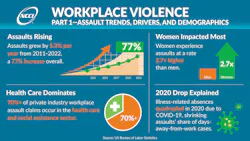
A recent survey, Workplace Violence, from the National Council on Compensation Insurance, which used the most recent US Bureau of Labor Statistics assault case data, found that workplace assaults show a clear upward trend: increasing at an annualized rate of 5.3% per year from 2011 to 2021–22.
Workplace violence spans a wide range of behaviors—from threats and verbal abuse to physical assault and homicide.
In the report, the group explores nonfatal workplace assaults as captured in the BLS Survey of Occupational Injuries and Illnesses.
Key findings of the report include:
The rate of workplace assaults per 10,000 full-time equivalent (FTE) workers increased by 62%.
The share of assaults among all of the BLS’ Days Away From Work (DAFW) cases increased from 1.3% in 2011 to a peak of 2.3% in 2019.
Assault cases are most heavily concentrated in the health care and social assistance NAICS sector. The number of annual assaults in this sector is 10 times the number of assaults in the next largest NAICS sector, retail trade.
Women tend to experience an elevated risk of workplace assault.
Workers aged 20 to 34 experience a disproportionate number of assaults.
Hitting, kicking, and beating by another person accounts for nearly 93% of all workplace assaults.
In the second installment of the report, which was released in May of this year, the group reported that workplace homicides account for:
- 400 to 500 cases per year on an all-ownership basis
- 350 to 400 cases per year on a private industry basis
- 8.5% to 9.5% of all workplace fatalities
The overall level of workplace homicides has remained broadly steady from 2011 through 2024, despite year-to-year volatility.
Gunshot and stabbing incidents make up the largest share of workplace homicides.
Men account for the vast majority of workplace homicide victims
"Workplace homicides have remained essentially flat over time, with only a temporary dip in 2020, and the stability of that trend stands in sharp contrast to both rising national homicide levels and the steady growth in nonfatal workplace assaults, the report said.
"The cases that do occur are concentrated in a narrow set of job environments—public-facing roles, cash-handling settings, lone-worker situations, and enforcement duties—which is why sales, food service, transportation, and protective-service occupations account for most workplace homicides.
"The demographic pattern follows the work: men make up the overwhelming majority of victims because they are disproportionately employed in the roles where lethal violence is most likely, while age differences are modest and largely mirror the broader labor force."