The Five Most Common Fire Protection Mistakes in Warehousing
Key Highlights
- Regularly review and update commodity classifications to ensure fire protection systems are correctly designed for stored materials.
- Maintain clear flue spaces between stored items to facilitate heat dissipation and water penetration during a fire event.
- Adhere to storage height limits and configurations as specified by fire codes, consulting professionals before making modifications.
- Implement a strong housekeeping program to keep aisles clear, prevent debris buildup, and ensure fire safety equipment is accessible.
- Conduct routine inspections, testing, and maintenance of fire protection systems, and establish procedures for managing system impairments.
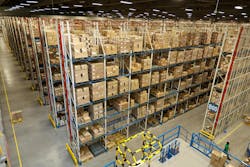
Warehouses are the backbone of modern supply chains, serving as hubs where goods are stored, sorted, and shipped. Since the COVID-19 pandemic, the growth of e-commerce has driven demand for more warehouse space, both in new construction and tenant expansions. Yet with vast floor areas, tall storage racks, and high fuel loads, warehouses present some of the most significant fire protection challenges in the built environment. A single fire can result in millions of dollars in losses, major business disruption, and, most importantly, risk to human life.
While fire and building codes and standards provide strong guidance, day-to-day mistakes in warehouse operations often undermine fire protection systems. Over my 18 years of fire protection experience and education, the following are the five most common errors that compromise warehouse fire safety.
Fire Hazard 1: Misclassified Commodities
Commodity classification, the process of identifying and categorizing hazardous stored goods, is the foundation of warehouse fire protection. NFPA 13: Standard for the Installation of Sprinkler Systems groups commodities from Class I through IV, with additional categories for high-hazard materials, such as plastics and flammable liquids, along with the actual commodity, the packaging materials involved, and how the item will be stored (i.e., wood pallets, unreinforced vs. reinforced plastic pallets, etc.). The commodity’s hazard level determines the fire sprinkler system(s) design criteria/schemes.
Best Practice: Conduct regular reviews of storage commodities, especially when product lines or packaging change, and involve a qualified fire protection engineer. For facilities with high-piled storage permits, annual reviews of the approved storage plan are critical to ensuring fire protection features and classifications remain accurate.
Fire Hazard 2: Blocked Flue Spaces
Flue spaces, or vertical gaps between stored materials, are critical because they allow heat to rise quickly to sprinklers and enable water to penetrate deep into racks as quickly as possible. NFPA 13 requires both transverse flue spaces (front-to-back gaps within a rack, perpendicular to the aisle) and longitudinal flue spaces (continuous gaps between back-to-back racks, parallel to the aisle), depending on the commodity and storage arrangement. It is a rare find when one walks into a high-piled storage area and the flue spaces are clear. These spaces are often encroached when pallets are pushed too far back, loads overhang, or items are stored too close together.
Best Practice: Maintain flue spaces through both engineering controls, such as rack spacers or pallet stops, and operational housekeeping. Train employees on proper pallet placement and perform routine audits to help ensure flue spaces remain open and effective.
Fire Hazard 3: Exceeded Storage Heights or Official Configurations Ignored/Altered
Fire protection engineers design sprinkler systems with limits on storage and ceiling heights and sprinkler clearance from the top of the storage. Fire protection standards, including NFPA 13, 30, 30B, and others, prescribe specific design schemes for specific storage parameters. Exceeding these limits (i.e., raising racks from 12 feet to 18 feet under the same sprinkler system) can overwhelm suppression capabilities.
Exceeding storage heights often happens when facilities try to increase capacity without consulting fire protection specialists or the local Authority Having Jurisdiction (AHJ). A few extra feet of storage may seem harmless, but it can mean the difference between effective control and system failure.
Best Practice: Document maximum storage heights and rack configurations, and post signage to reinforce compliance. Many times, these “signs” are a strip of red tape placed around all the adjacent columns for an easy visual representation of storage heights. Any changes should trigger a review by fire protection professionals before implementation.
Fire Hazard 4: Poor Housekeeping
Oftentimes, employees place items in an area with the intention of it being temporary, but are unaware of the fire hazards those items pose. A fire can happen at any time, and those “temporary” solutions may obstruct fire sprinklers, extinguishers, or egress/fire department access.
Best Practice: These hazards can be mitigated by implementing a “fire-safe” culture at the facility level. Implement strong housekeeping programs with regular walkthroughs to check aisle clearance, sprinkler spacing, and removal of debris. Many organizations assign the fire safety duties to an employee within the warehouse to monitor compliance on a daily/weekly/monthly basis. Ongoing housekeeping and fire safety training are key to maintaining an appropriate fire safety culture.
Fire Hazard 5: Neglected System Inspections, Testing, and Maintenance (IT&M)
One of the most preventable causes of warehouse fire loss is failing to maintain fire protection systems. Issues often arise from missed IT&M intervals, leaving warehouses with critical gaps in protection. Some examples of critical items that may be missed due to a lack of maintenance include:
- closed valves
- disabled fire pumps
- neglected hydrants
- faulty or obstructed ancillary equipment (hoses, extinguishers, fire detection, and notification)
Additionally, impairments can be equally as dangerous when managed improperly. The facility’s fire supervisors must follow the impairment strategies, such as fire watch, as directed/required by the local fire department. All impairments should be discussed with your fire protection professional and the local responding fire department.
Best Practice: Follow all IT&M schedules and maintain thorough records. Establish clear impairment procedures that include tagging, notifications, and temporary safeguards until systems are restored. If there are any areas to forego when attempting to adhere to a strict budget, fire protection should not be one of them.
Conclusion
Fire protection in warehouses is not just about sprinklers; it requires ongoing planning, training, and practice to maintain system effectiveness. Improper equipment, poor maintenance, and inadequate training can devastate not only business flow but also a facility’s greatest asset, its employees.
The best way to address common issues is by embedding fire safety into facility culture. Regular training keeps knowledge fresh while educating new hires.
Ultimately, preventing warehouse fire losses demands a culture where fire safety is part of daily operations and every employee understands that their actions count.
About the Author
 Michael Willis
Michael Willis
Michael Willis, CFPS, is the Regional Practice Leader for Telgian Engineering & Consulting. He holds NICET certifications in fire alarm and sprinkler systems, multiple state licenses, and is a candidate for PE licensure in Fire Protection Engineering.