Podcast: Employee Engagement Key to Successful Safety Culture

Jennifer Ferdinand-Stong has seen a common theme across her career, which has taken her from launching safety programs at data center facilities to safety director at a drywall contractor to her current job as corporate safety manager at Gaylor Electric.
An engaged workforce delivers the best safety results.
Her results have been celebrated as she was recently named the first-ever Health and Safety Professional of the Year by the Associated Builders and Contractors (ABC) for 2026.
On this podcast, Ferdinand-Stong discusses her safety philosophy, how she manages her team and why it's essential to have field work experience to deliver optimal safety performance.
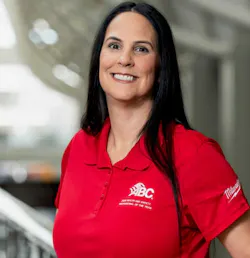
The following is an excerpt from the podcast.
EHS Today: What is your overall safety philosophy?
Jenny Ferdinand-Stong: My philosophy on safety meshes many different disciplines and thought processes. It's not just about the book. And you'll hear me say that all the time out in the field. It's about the processes, how we're doing the work, the individual doing the work, and where we're at.
It's about coaching and empowering our people to know they are safety leaders, no matter their position. You are a leader; you are responsible for your own safety, and you have a duty to your brother and sister next to you. I wholeheartedly believe that you need to empower each person and give them the tools that they need.
EHS Today: Since you've been in the field for a while, can you talk about what barriers or challenges you have faced over the years as an EHS professional and how you were able to overcome them?
Ferdinand-Stong: One of the barriers that I personally have faced is understanding the relationship with the person I'm working with. A lot of times it has been that trust factor. Do they trust my knowledge and my experience, and therefore what I am telling them?
Instead of a person saying, "Hey, this is what my book says, or this is what the policy says," it's going in and saying, "Hey, I see that we have to do this. This is not safe, but let's make it as safe as possible."
Let's understand the challenges that they're facing in that situation or why they feel like they have to do it a certain way and then you have to circle around and say, no, we need to do it this way.
However, it's looking at both sides. I ask what my colleague is thinking. And you hear all these different ideas and sometimes you let them know it's brilliant. Or sometimes you reply that you like where they are coming from, but that's not going to work today.
So that's one of the biggest challenges is having a team trust your knowledge.
EHS Today: Looking ahead at the next few years, what do you feel are the safety trends that companies will have to consider?
Ferdinand-Stong: As we all know, there's an age gap currently when we talk about construction — what we have as far as our workers that are aging out and who's coming in. It's getting better, but there is still a huge age gap.
So I think that one of the safety trends that we're really going to have to consider is new to construction. And that is that there might be some people entering the field that have never even picked up a tool.
It's not a bad thing, but what makes it challenging is that often we don't have the mentorship for those individuals. And I believe that it's going to be the mentorship that will help these new workers learn how to become part of a strong safety culture.
About the Author
 Adrienne Selko
Adrienne Selko
Senior Editor
Email [email protected]
Adrienne Selko is also the senior editor at Material Handling and Logistics and is a former editor of IndustryWeek.