Why AI Should Never be Responsible for Warehouse Safety
Key Highlights
- Warehouses are chaotic and complicated places. Employers have an obligation to use all tools at their disposal to make them safer.
- AI can improve navigation, routing and operational efficiency, but safety must remain separate from AI-driven autonomy because AI behavior can be unpredictable in edge cases.
- That’s why safeguards must be implemented and additional precautions taken to prevent countless potential accidents and disasters.
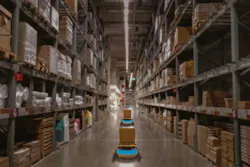
Artificial intelligence (AI), particularly the perception, navigation and decision-making systems that power robotics, was tailor-made for warehouses. You’d be hard-pressed to find an industry better suited for AI-powered robotics, which have already taken root in warehouses across the world.
These robots have quickly gotten the hang of navigating complex environments and handling varied tasks. What’s more, these solutions are operating with greater autonomy than any previous generation of equipment, prompting operations teams to ask: Is there anything they can’t do?
AI can improve many aspects of warehouse operations: how a robot navigates a facility, how it learns from repeated trips, and how it adapts routes around congestion or unexpected obstacles. These are real capabilities that add genuine value to warehouse operations.
But safety belongs in a separate category; it’s the third rail of warehouse automation. While AI can guide how robots move, the systems that prevent collisions and protect workers must be independent and fail-safe.
A warehouse is a constantly evolving ecosystem filled with people, equipment, aisles, blind corners and constant motion. Things can go wrong. When that happens, it can put employees' safety at risk. In that setting, safety cannot depend on a system that may interpret a situation in unpredictable ways or reach a conclusion that no one can fully explain after the fact.
Separating Autonomy and Safety
AI cannot be the system responsible for deciding whether a robot stops before it reaches a worker, whether it maintains safe separation in a tight aisle or whether it can continue operating under hazardous conditions. The safety layer must function independently, especially when the AI gets something wrong (which it will).
When a safety system, the software layer responsible for detecting hazards or triggering protective actions, is AI-based, there is no complete understanding of how it will behave in every situation, and there is no true fail-safe. That concern is reflected in a core safety engineering concept known as performance level, which rates how reliably a safety function operates, including under failure conditions. Achieving a high performance level rating requires the safety system to operate independently, regardless of whether the AI navigation model has correctly interpreted the environment around it.
AI hallucinations are a familiar concept to anyone who has spent time with large language models. Ask a chatbot a factual question, and it will sometimes return a confident answer that is completely fabricated. In a software context, this can be an inconvenience. In a warehouse, the equivalent failure involves a 3,000-pound autonomous vehicle moving through a space where workers are present. The unpredictability that produces a hallucinated citation in a research tool produces something categorically different when the system in question is making real-time decisions about physical movement.
The nature of a warehouse environment is also a complicating factor. These are physical locations with real-life employees. Blind corners, a misplaced ladder, variable lighting, seasonal congestion, workers walking around listening to their wireless headphones—these are all irregularities that need to be anticipated. It’s one thing for an AI navigation system to operate in this type of environment; it can learn and improve. But an AI safety system operating in the same environment where its behavior in edge cases is unpredictable is an entirely different proposition.
To manage that risk, teams must define a safety layer that operates independently of the AI layer. The safety system must respond according to defined, verifiable logic rather than probabilistic judgment. It should monitor proximity, sensor thresholds, speed limits and emergency conditions without relying on the AI navigation model to interpret the full context of what’s taking place. Safety functions need predictable behavior under failure conditions. The system responsible for stopping the robot must work even when the robot’s navigation system misreads the environment, loses confidence or fails.
Standards and Deployment Risk
The architecture of the robot is one part of the safety picture. The deployment environment is an entirely different consideration.
ANSI R 1508 Part 2, a standard developed with input from safety and robotics professionals across the industry, now requires organizations that deploy warehouse robots to conduct site-specific risk assessments before installation. This is a shift from how industrial robotics standards have historically worked, when previous standards applied primarily to manufacturers. Part 2 extends the obligation to the operators, the warehouses and distribution centers putting the equipment to work.
The reason is straightforward: A robot that passes every possible certification in a controlled environment is going to be deployed in an environment with variables that no certification process can anticipate. That’s where the site-specific risk assessment comes in. It has nothing to do with AI.
Organizations need to make sure they have answers for questions about risks, including: What are the floor conditions? Do we have potential problems with potholes or uneven surfaces? What about overhead obstructions and tight passageways?
Every site is unique, and the deployment plan must account for the specific factors affecting each deployment. The same checklist that works for a new greenfield facility is worthless when you’re deploying a robot in a 40-year-old distribution center with mixed flooring and columns in varied locations.
In 2018, a robot at a fulfillment center in New Jersey punctured an aerosol can of bear repellent during normal operation. The chemicals spread across the floor, and ultimately, more than 50 workers were treated on-site and 24 were hospitalized. The robot did exactly what it was designed to do. The safety system had simply never accounted for what it was carrying. A site-specific risk assessment conducted before deployment is what catches that kind of gap.
Preparing for Humanoid Robotics
The principles that apply to warehouse autonomous mobile robots (AMRs) will eventually need to apply to humanoid robots as well, though the current state of humanoid safety standards suggests that timeline is still years away.
Many humanoid robots operating in pilot programs today are fully AI-operated and have not yet been held to mature safety standards. The question worth asking is whether the industry is solving the foundational problems before those pilot programs scale into broader deployment.
One concern that comes up specifically among safety professionals is fail-safe behavior during power loss. A warehouse AMR that loses battery power stops and stays stopped. A bipedal humanoid that loses power falls wherever the robot is standing when the battery runs out. Near an exit, near a worker, near a charging station with other equipment around it. With weights of up to 150 pounds, moving a bipedal humanoid becomes a safety concern for nearby workers.
Safety standards for humanoids are only beginning to take shape, and the gap between where those standards are and where the technology is moving is a genuine concern for anyone working on industrial safety policy. That concern reaches beyond humanoids. Once AI moves from software into physical systems, safety has to be engineered differently. A software failure can create a bad answer, a delay or a financial mistake. A failure in an industrial environment can injure someone. That difference changes the engineering requirements. Therefore, the systems that make robots autonomous should be separate from the systems that keep people safe.
Warehouse operators evaluating automation vendors should be asking directly how the safety system is architected and what happens when the AI system is wrong or unavailable. They should be asking what performance level the safety system is certified to, how the site-specific risk assessment is conducted, and what the training obligations look like for workers at launch and for staff hired afterward. Those questions will determine whether a deployment holds up over time.
AI, automation and robotics can transform warehouse operations, but those benefits depend on safety being prioritized from the start. Ultimately, the systems that make robots autonomous should never be the same systems responsible for keeping workers safe.
About the Author
Michael Bearman
Michael Bearman, JD, is chief legal and safety officer of Vecna Robotics, a provider of autonomous mobile robots (AMRs) and material handling automation software platform.