Rooftops Are Getting Crowded. Your Fall Protection Program Has to Catch Up.
Key Highlights
- Rooftop equipment density is rising across manufacturing, utilities, and commercial facilities as HVAC systems, solar arrays, and mission-critical infrastructure move skyward, creating more frequent worker exposure to fall hazards at height.
- The hierarchy of controls calls for passive, engineered protection like guardrails and platforms before reliance on personal fall arrest systems, yet many facilities still default to a PPE-first approach for routine rooftop maintenance.
- Kee Platform provides modular, OSHA-compliant work platforms built with Kee Klamp components that can be designed for specific equipment configurations, installed without roof membrane penetration, and reengineered in place as facility layouts evolve.
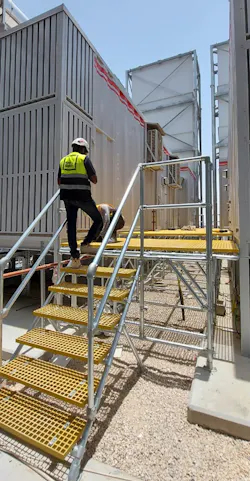
As HVAC loads grow, solar arrays expand, and mission-critical equipment moves skyward, EHS leaders face a new kind of rooftop. Here’s what it takes to protect workers on it.
Walk onto the roof of a modern manufacturing plant, utility substation, or large commercial project today and you’ll see something unrecognizable from a decade ago. What used to be an empty membrane with a few exhaust fans is now a working floor: packaged rooftop units, condensers, solar arrays, battery storage enclosures, generator sets, and in some facilities, dozens of chillers and cooling towers running around the clock. Electrification, on-site power, and growing thermal demand have turned the roof into critical infrastructure, and one of the busiest, highest-risk work zones on the property.
For EHS leaders, the implications are direct. More equipment means more scheduled maintenance, more workers at height, more often, in more places. Falls from elevation remain a leading cause of fatal workplace injury in general industry. The question is no longer whether rooftop exposure is a program priority. It’s whether your program is built for the rooftop you actually have.
The Hierarchy of Controls Still Applies, Even When It’s Inconvenient
The hierarchy of controls hasn’t changed, but the way rooftops are being used has. Eliminating the hazard is rarely possible; equipment has to be serviced where it lives. That leaves engineering controls (guardrails, platforms, walkways, and other forms of passive, collective protection) as the first line of defense before any reliance on personal fall arrest systems.
That sequence matters because passive protection works on every worker who enters the area, every time, without requiring training verification, PPE inspection, or tie-off discipline. A contractor’s new technician, a third-party HVAC tech, or a first responder all receive the same protection the moment they step onto a guarded work zone.
Yet many facilities still default to a PPE-first approach for routine rooftop work that could be fully engineered out. Under OSHA 29 CFR 1910.28, that gap is both a compliance exposure and a missed opportunity. Collective, permanent protection reduces incident severity, simplifies audits, and takes the “did the crew actually tie off?” question out of the daily equation.
Three Exposures Driving New Rooftop Risk
Facility cooling loads have grown with production density, process-heat recovery requirements, and tighter indoor environmental specifications. Many manufacturing rooftops now carry condenser banks, RTU fleets, and chillers that require weekly or monthly service rounds, often within narrow access corridors between units.
Rooftop solar adds another layer. Utility and industrial owners adding PV arrays create a permanent population of workers who need safe access to panels, inverters, combiners, and DC disconnects for commissioning, O&M, and storm inspections. Solar also introduces tripping hazards, cable runs, and work surfaces at unusual heights.
Meanwhile, emergency generators, transfer switches, battery energy storage, and communications equipment increasingly sit on rooftops where technicians have to respond quickly, in any weather, day or night. Speed of access matters, but speed without engineered protection is where incidents happen.
Each of these exposures is recurring, predictable, and performed by a rotating mix of employees and outside contractors. That is exactly where permanent, passive protection pays off most clearly, and where portable ladders and job-by-job tie-off plans are least defensible.
What “Engineered Access” Actually Means
An engineered access platform is not a stock product pulled off a shelf. It’s a permanent, load-rated work surface designed around the equipment it serves, installed so technicians stand at the correct working height with every service point in reach and every open side protected.
Effective platforms share a common set of features: a level, non-slip work surface at the correct service height; integrated guardrails meeting the OSHA 42-inch top-rail and 200-pound load requirements; self-closing gates at access points; toe boards; and load ratings sized for the dynamic loads of real maintenance activity, not static weight alone.
The Kee Platform system is built around this philosophy. Using Kee Klamp modular tubular components, each static or mobile platform is designed for its specific application, built to meet OSHA 29 CFR 1910.23 and 1910.29, and delivered with CAD drawings so owners and contractors know exactly what they’re getting. If equipment changes later, platforms can be reengineered in place, a meaningful advantage where facility layouts evolve faster than capital plans.
A Data Center Example
Consider a hyperscale Data Center where dozens of cooling towers and chillers share rooftop space with generator sets, switchgear, and connectivity equipment. Technicians access that equipment weekly, often under time pressure, and any membrane penetration can jeopardize both waterproofing and manufacturer warranty, a serious issue when uptime is measured in minutes per year.
Engineered, non-penetrating Kee Platform systems solve both problems. Weighted bases distribute load across the membrane without fastening through it. Platforms are sized to put workers at the right height for each unit, with guardrails on all open sides and integrated stair or ladder access. The same modular approach extends to Kee Walk rooftop walkways and Kee Guard perimeter railings, creating a continuous, compliant safe-access network across the entire roof. The same playbook applies wherever rooftop equipment density is rising, from food and beverage plants to utility control buildings to logistics facilities retrofitting for solar.
Building the Program
For EHS leaders looking at today’s rooftop, and planning for the one coming in the next capital cycle, three questions drive the work. Where is elevated work happening today, and how often? Which of those exposures can be eliminated or fully engineered away with permanent, passive protection?
Kee Safety offers hazard assessment surveys, design and installation, and ongoing inspection and recertification services to help answer those questions before the next maintenance cycle, not after an incident. To learn more about Kee Platform and the full Kee Safety rooftop system, visit keesafety.com.
Sponsored By: