Storm Season Puts Workers on Your Roof. What Happens When They Get There?
Key Highlights
- A storm can send five or more unfamiliar contractor crews to a facility rooftop within 48 hours, all subject to the same OSHA fall protection requirements as any scheduled maintenance worker.
- Post-storm urgency is where personal fall arrest systems are least likely to be properly used, making passive engineering controls the only protection that reliably covers every worker regardless of their training or employer.
- Non-penetrating perimeter guardrail and rooftop walkway systems provide permanent, OSHA-compliant fall protection that requires no action from the worker and can be installed without compromising roof membrane warranties.
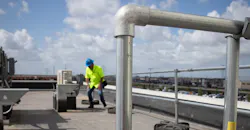
When a severe weather event hits a facility, the phones start ringing before the storm is over. Roofing contractors. HVAC service crews. Insurance adjusters. Equipment technicians checking on generators, solar arrays, and communications infrastructure. Within 24 to 72 hours of a significant event, a rotating cast of workers descends on rooftops across the region, most of them unfamiliar with the specific roofs they’re being sent to, many of them under pressure to move fast.
That combination of urgency, unfamiliarity, and a potentially compromised roof is where fall incidents happen. The question for EHS leaders isn’t whether storm season puts workers on their roofs. It’s whether those roofs are ready before the first storm arrives.
The Storm-Driven Workforce
Post-storm rooftop access involves a broader workforce than most facilities plan for. The roofing contractor assessing membrane damage is likely a crew that has never been on this specific roof. The insurance adjuster documenting hail impact on HVAC units may have no rooftop safety training at all. The solar O&M technician checking for panel damage after a high-wind event is working for a separate company under a separate service contract, with no visibility into what the facility’s standard safety procedures require.
Add to that the equipment-specific crews: generator technicians checking transfer switches and fuel levels, communications contractors restoring antenna and relay equipment, building automation teams resetting rooftop sensors after a power event. In a large facility after a significant storm, five or more separate contractor crews may access the roof in the same 48-hour window.
Under OSHA’s multi-employer worksite doctrine, the facility is the controlling employer for all of them. The compliance obligation, and the liability exposure, doesn’t follow the contractor’s safety manual. It follows the conditions on the roof.
Why Urgency Is the Enemy of Administrative Controls
Personal fall arrest systems work when workers are trained, when anchors are identified and rated, when equipment is inspected before use, and when the worker feels comfortable slowing down long enough to tie off. Under normal scheduled maintenance conditions, that chain of steps is manageable. After a storm, it frequently isn’t.
An insurance adjuster on a post-storm inspection may not be trained in fall arrest systems. A roofing contractor working across multiple storm-damaged properties in a single day is moving quickly and may not be familiar with which anchor points on a given roof are rated for arrest loads. An equipment technician responding to a 2am generator alarm is not pausing for a pre-task safety briefing.
Administrative controls like training requirements, tie-off procedures, and job hazard analyses are effective when conditions support them. Storm-driven rooftop access routinely does not. This is precisely the scenario where passive, permanent engineering controls provide protection that administrative controls cannot.
A guardrail doesn’t require the worker to do anything except stay inside it. A defined walkway path requires only that the worker follow it. Permanent engineering controls extend protection to every worker who steps onto the roof, regardless of their employer, their training, or the urgency of the task that brought them there.
What Changes on a Roof After a Storm
Beyond the workforce considerations, the roof itself is a different environment in the aftermath of a severe weather event. Standing water on membrane surfaces reduces traction. Debris including branches, gravel, and displaced equipment components creates trip hazards across access paths. Hail impact can compromise the structural integrity of skylight covers that were rated before the storm but may not be after it. High winds can displace or damage equipment that previously defined safe access corridors.
Rooftop edges are a particular concern after high-wind events. Flashing damage, displaced coping, and membrane uplift at the perimeter create conditions where workers, particularly those unfamiliar with the specific roofline, may not recognize that a previously secure edge is no longer stable. Permanent perimeter guardrail systems that meet OSHA’s 42-inch top-rail and 200-pound point-load requirements provide a consistent, visible boundary regardless of what the storm did to the surface behind them.
OSHA Doesn’t Suspend When the Weather Does
Emergency response conditions do not modify the requirements of 29 CFR 1910.28. Fall protection at four feet or more is required regardless of how the worker came to be on the roof or how urgently they need to be there. Post-storm incidents that result in injury trigger inspections that evaluate conditions as they existed, not as the facility intended them to be and not with an accommodation for the disruption of the event.
Facilities that have not established permanent fall protection frequently discover during post-incident investigations that their standard procedure of issuing harnesses and requiring tie-off was not followed during the storm response window. That gap between the written procedure and actual field conditions is a recurring finding in OSHA citations following storm-related rooftop incidents.
Protection That Works Before the Storm and After
Non-penetrating perimeter guardrail systems and rooftop walkways from Kee Safety are permanent installations designed to perform across the full range of conditions a rooftop encounters: scheduled maintenance, routine inspections, and post-storm emergency access alike. Because they don’t require membrane penetration, they can be installed on virtually any commercial or industrial roof without compromising waterproofing warranties, and they remain in place and functional before, during, and after storm season.
For facilities that have not completed a formal rooftop hazard assessment, storm season is the clearest argument for doing it now. The assessment identifies every point of elevated exposure, documents the workers and frequencies involved, and produces a prioritized remediation plan before the next event puts an unfamiliar crew on an unprepared roof.
Kee Safety provides hazard assessment services, engineering and design, installation, and ongoing inspection and recertification for complete rooftop fall protection programs. To learn more, visit keesafety.com.
Sponsored By: