The 4 Ms of Manufacturing: A Framework for Smarter EHS
Key Highlights
- The 4 Ms of Manufacturing, Man, Machine, Materials, and Methods, provide a practical framework for identifying risk and strengthening workplace safety.
- The most effective EHS programs recognize that protecting workers requires managing people, equipment, materials, and processes as one interconnected system.
- Putting workers at the center of the 4 Ms helps organizations reduce incidents, improve compliance, and build a stronger, more resilient safety culture.
Environment, Health, and Safety (EHS) in manufacturing is complex. There are machines running at full capacity, chemicals being handled, processes being followed, and workers working. When an injury incident occurs, it’s critical to investigate the circumstances around it fully and to develop effective countermeasures to prevent similar incidents from re-occurring.
Experienced EHS professionals don't look at safety in isolation. They think in systems. And one effective framework for doing so is 4 Ms of Manufacturing: Man, Machine, Materials, and Methods. This framework emerged out of industrial engineering, specifically statistical quality control, and is helpful in organizing our thoughts when investigating or building systems to prevent incidents and illnesses in the workplace.
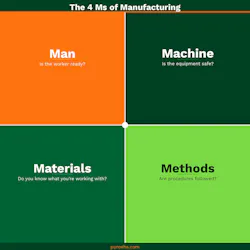
Each of the 4 quadrants shown above represents a critical dimension of your workplace. And when applied to safety, they give you a complete picture of where risk lives, and where gaps may exist in your safety system.
Man: The Worker at the Center
The "Man" quadrant is about your people and asks the simple question: “Is the worker ready?” - and it's the most important one. Are workers properly trained? Do they understand the hazards of their job? Are they physically and mentally fit to perform their tasks safely?
When considering the worker themselves, we must ensure that your hire is fit to work, and, through medical surveillance, remains so throughout their career. To do so, many employ Occupational Health professionals directly or contract with local clinics to complete a health screening and then monitor the health of that worker at regular intervals.
The data collected supports the fit to work decision and is the baseline of the employees' health record with retention requirements for up to 30 years.
Machine: Equipment That Works - and Doesn't Harm
Manufacturing environments depend on machines, equipment and tools, and they need to be designed for safe operation and to prevent creating hazardous conditions. Here we ask, “Is the equipment safe?”
A machine that isn't properly maintained is a machine waiting to cause harm. Equally important are the safeguards built around equipment including the physical barriers, interlocks, and protocols that stand between the worker and serious injury. When those fail or are bypassed, the consequences can be catastrophic.
Strong EHS programs treat machine safety as an ongoing discipline, not a one-time activity. Regular inspections, preventative maintenance schedules, and clear operating limits keep equipment-related risk in check and serve as a record that the company understands the status of their equipment.
Materials: Know What You're Working With
Every manufacturing environment involves materials including raw inputs, parts, chemicals, and finished goods that workers handle every day. The Materials quadrant is about understanding what those substances are, the risk they carry, and asking “how do I manage these materials safely”.
Examples of sound material management include maintaining up-to-date Safety Data Sheets (SDS), ensuring proper labeling and storage, training workers on hazards, and monitoring exposure levels. It also extends to the physical demands of handling these materials and protecting individuals if exposed during an incident. Many systems exist to help maintain compliance regarding chemical hazards in the workplace, from 3-ring binders (yes, they are still out there) to on-line and app-based systems that put these important documents at your fingertips.
Methods: How Work Gets Done
The Methods quadrant covers your processes, policies, and procedures. Safe work instructions, standard operating procedures, permit-to-work systems, and behavioral safety programs all live here. This is the "how" of your safe operation.
Even the safest equipment can be undone by poor processes. Methods create consistency and ensure that safety isn't dependent on any one person's judgment on any given day. When methods are clear, documented, and followed, the entire system becomes more predictable and more reliable.
All Four, All the Time
The power of the 4 M's framework isn't in any single quadrant - it's in seeing their interaction. A new material introduced on the floor affects worker training (Man), handling procedures (Methods), and storage requirements. A machine upgrade changes the skills workers need and the processes they follow. Nothing operates in a vacuum.
Effective EHS management means monitoring all four dimensions, continuously, and understanding how changes in one area ripple through the others.
At PureEHS, we specialize in ensuring the worker is always at the center. Our software is built specifically to keep your people safe and your business compliant. Schedule a meeting to learn more about how we can help.
Sponsored By: