OSHA's Strategic Shift Emphasizes Resources, Technology and Better Communication
Key Highlights
- OSHA's new programs focus on helping companies improve safety through continuous learning and resource sharing.
- The agency aims to balance enforcement with proactive safety support, especially for small and medium-sized businesses.
- David Keeling highlighted plans to incorporate AI and predictive analytics to better prevent workplace injuries and fatalities.
- OSHA intends to train inspectors to provide practical guidance and share best practices during visits.
- The leadership emphasizes a comprehensive approach, using all available tools and strategies to lead workplace safety improvements.
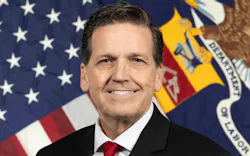
Last week, the Occupational Safety and Health Administration (OSHA) launched two new workplace safety programs: the Safety Champions Program, aimed at helping companies establish and continuously improve their safety and health programs; and OSHA CARES, a customer service-focused initiative aimed at making it easier for companies to gain access to OSHA’s resources. At a LinkedIn Live event on March 23, David Keeling, Assistant Secretary of Labor for Occupational Safety and Health and the head of OSHA, offered more details on the new programs, as well as an update as to what direction OSHA will take under his leadership.
“OSHA is an enforcement agency and we’re going to remain an enforcement agency,” Keeling said. “But what the OSHA CARES program can do for us is reinforce our position as a resource, especially for small and medium-sized businesses. The intent is to improve our communication and coordination with all agencies and employees and workers.”
He cited conversations he’s had with safety managers in the past who’d had contact with one of the federal agencies, such as OSHA, EPA, DOT, FMCSA, and he would ask them, “What did the inspector leave you with after the visit?” Usually, he’d hear something like, “No citations, no fines, so we must be doing great, right?” But that, Keeling noted, wasn’t really the question.
“The question is, ‘How can we get better? And what did the inspector leave you with?’ So that’s what he intends to focus on – training the OSHA inspectors to help companies learn how to do things better, by sharing best practices and practical information.
Acknowledging the reality that Republican-led OSHAs have historically been more closely aligned with companies than with workers, Keeling said there will be some changes in OSHA’s enforcement posture. “That’s not to say we’re not going to hold people accountable, or that we’re no longer an enforcement agency. We all know there are bad actors, and we absolutely are going to hold them accountable. But we have an opportunity to use our resources more effectively.”
Keeling used the analogy of a golfer having a full set of clubs in his bag. “I’m not a very good golfer, but I do try to use all the clubs in the bag when I play. And for OSHA, if we’re only focused on enforcement, we’re only using a few of our clubs and leaving the rest in the bag. And we may have seen administrations in the past who focused only on compliance, or on collaboration, or on resources. If you’re only focused on one thing, then you’re leaving clubs in your bag. So we really want to use all of our clubs, so to speak.”
Answering a question posed by EHS Today about OSHA’s plans to adopt new technologies such as AI, Keeling said, “I think AI is a great tool. We’re looking at how we can use it to measure success, and how quickly we can get the numbers in to measure success, and what kind of AI tools we can give to our inspectors.” For instance, referring back to the idea of inspectors leaving resources behind with a company after a visit, Keeling offered as an example a risk assessment created using AI, or a language tool that can support businesses that operate in a multitude of languages. OSHA also plans to get more aggressive on its adoption of predictive analytics, particularly to help companies better anticipate and prevent serious injuries and fatalities (SIFs).
“We’re not afraid of AI. We know there will be bumps in the road; we know we’ll hit things and realize, that didn’t work and we’ll have to go a different direction. But we really think there’s a huge opportunity because AI is a great tool. We should embrace it and use it where it’s appropriate.”
Summarizing the approach he plans to take with OSHA (Keeling was confirmed in his post last October), Keeling said, “We need to be looking for ways to lead. We want to be in the abatement business and we want to be in the solutions business, and not just in the enforcement business.”
About the Author
 Dave Blanchard
Dave Blanchard
Editor-in-Chief / Senior Director of Content
During his career Dave Blanchard has led the editorial management of many of Endeavor Business Media's best-known brands, including IndustryWeek, EHS Today, Material Handling & Logistics, Logistics Today, Supply Chain Technology News, and Business Finance. In addition, he serves as senior content director of the annual Safety Leadership Conference. With over 30 years of B2B media experience, Dave literally wrote the book on supply chain management, Supply Chain Management Best Practices (John Wiley & Sons, 2021), which has been translated into several languages and is currently in its third edition. Prior to joining Endeavor/Informa/Penton, he spent a decade covering the artificial intelligence industry. He is a frequent speaker and moderator at major trade shows and conferences, and has won numerous awards for writing and editing. He is a voting member of the jury of the Logistics Hall of Fame, and is a graduate of Northern Illinois University.