America's Safest Companies 2026: AFL
Editor's Note: The 2026 class of America's Safety Companies will be recognized Tuesday, September 22, during a live webinar beginning at 2:00 PM (EDT). More information about the webinar can be found at the registration site for How to Create and Sustain a World-Class Safety Culture: Insights from America's Safest Companies of 2026.
AFL
Telecommunication, Wire & Cable Manufacture and Installation
Duncan, SC
2,000 employees | 7 sites | 16 EHS professionals
AFL is looking toward the future—the distant future.
The company—a global manufacturer that specializes in fiber optic cable and hardware, transmission/compression and substation accessories, connectivity solutions, fusion splicers, and test and inspection equipment—evaluates capital projects, equipment purchases and facility designs by considering how best to keep people safe 30 years from now.
To help turn that future into a reality, the company develops a multi-year safety strategy that aligns with business growth, operational excellence and workforce well-being by connecting lagging indicators with leading indicators. AFL uses leading indicators, such as corrective-action closure and Serious Injury and Fatality potential identification, as the primary measure of safety effectiveness and culture. Lagging metrics, meanwhile, are used to validate long-term trends but are not considered a reliable assessment of system health or performance.
“This approach confirms that controls are in place and effective—not that we were simply fortunate,” says Larry Pearlman, vice president of environmental, health, safety and security. “Safety plays a central and defining role in how our company operates and competes. It is not treated as a compliance obligation or a support function but as a core business expectation that shapes leadership behavior, operational decision‑making and how we engage with customers.”
AFL’s safety program is deliberately centered around the idea that the absence of injuries does not mean an absence of risk. The company is proactive in its efforts to mitigate risk, strengthen culture and improve system reliability through leadership accountability, associate engagement and forward‑looking metrics.
"The same disciplines that prevent injuries—planning work, controlling energy, maintaining equipment, engaging employees, and verifying execution—also drive quality, reliability, and productivity," Pearlman says. "Strong safety performance signals to our customers that we can be trusted to operate with discipline in complex, high‑risk environments."
Leaders are expected to actively engage in hazard identification, verify that controls are in place and model safe behaviors. What’s more, participation, risk identification and corrective action follow‑through are treated as indicators of leadership effectiveness.
Employees are encouraged to report near-misses, hazard identification and other safety concerns. AFL emphasizes learning rather than blame by providing feedback that shows how their input leads to corrective actions or tangible improvements.
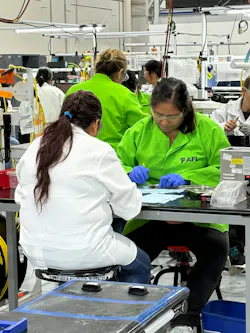
Associates are invited to participate in safety alongside supervisors and EHS leadership. Nearly three-quarters (73%) of manufacturing associates are actively engaged in formal safety activities, such as safety committee involvement, near-miss reporting, audit participation and hazard identification or Kaizen participation. The company’s participation target for this year is 95%.
The company uses these channels to create opportunities to not only raise concerns but also share ideas and actively help develop solutions. It's no wonder, then, that associate engagement surveys show a double-digit improvement in perceptions of safety. Pearlman says it's validation that their approach is reducing risk while also increasing trust, care and confidence.
We treat safety culture as something that must be developed and verified, not assumed.
"We protect our people through intention, investment and a culture that truly cares," he says. "We also recognize that safety is a journey, not a destination. We view recognition as an affirmation of our trajectory, not our results."
To tangibly buttress the importance of safety, both management and front‑line associates are eligible for incentives tied to achieving safety engagement targets.
“Together, these approaches foster broad involvement, reinforce psychological safety, and signal that every employee has a voice and responsibility in managing workplace risk,” Pearlman says. "We intentionally design our safety programs to invite participation from associates at all levels, roles, and locations, reinforcing that everyone’s voice matters when it comes to identifying risk and preventing harm."
The message is clear in all that AFL does, from leadership communications to business reviews to performance reviews to engaging with customers: protecting people is nonnegotiable and shortcuts that introduce risk are unacceptable.
“AFL’s safety performance is not accidental; it is the result of enterprise‑wide alignment, disciplined risk management and sustained investment,” Pearlman says. “Every major part of our business uses a formal risk matrix and risk register to identify, prioritize and manage exposure. This common risk language allows leadership to focus resources where they matter most and ensures that high‑consequence risks are addressed consistently across the organization, not in silos.”
Read More:
About the Author
 Nicole Stempak
Nicole Stempak
Nicole Stempak is managing editor of EHS Today and conference content manager of the Safety Leadership Conference.