Managing Electrical Safety and Arc Flash Risk in Open Working Environments
Key Highlights
- Electrical crews rarely operate in ideal conditions.
- Most of the time, crews are making repairs and improvements in vast, open spaces. That makes workers more vulnerable to risks and hazardous conditions.
- The key to safe work, then, is identifying and controlling risks at every part of the process.
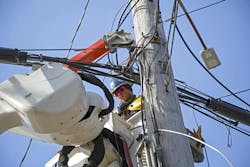
Arc flash risk does not stop at the switchgear. It follows crews into streets and substations, campuses and hospital roofs, data-center yards, and storm-damaged neighborhoods. In the open, hazards expand due to weather, public proximity, traffic, backfeed from generators or distributed energy resources (DERs), and unpredictable re‑energization. The question is not whether these variables exist, but whether planning, methods and culture are built to eliminate risks.
Start where the risk starts.
Electrical safety is often taught as a set of tasks: testing, locking, tagging, donning personal protective equipment (PPE), and proceeding. In an open environment, that task list can blind us to additional energy hazards not associated with the electrical equipment being worked on.
A more reliable starting point is a structured scan of all hazardous energies interacting with the job and environment, including electrical, mechanical, gravitational, pressure, thermal and chemical energies. My teams use a simple visual “hazard wheel” in prejob briefings to force that scan—before any tool touches a panel cover or a pole step. The approach offers two key benefits:
- We identify nonobvious sources of electrical energy (e.g., customer-owned generators, photovoltaic (PV) backfeed and auto-reclosers).
- We examine how other energy sources (e.g., wind, traffic and suspended loads) amplify electrical risk.
This energy-first view aligns naturally with the Hierarchy of Risk Controls in NFPA 70E:
- First, eliminate or substitute hazardous conditions.
- Then, engineer out exposure.
- Next, lean on administrative controls next.
- Finally, reserve PPE as the final barrier when risk remains.
In practice, this means we obsess over de-energization and isolation before discussing gloves and arc rated suits.
De-energize by default.
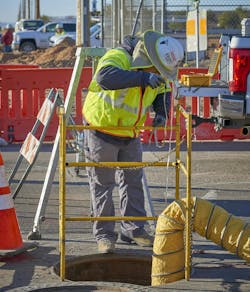
Live parts to which an employee may be exposed must be de‑energized unless doing so is infeasible or creates a greater hazard, according to the Occupational Safety and Health Administration (OSHA). In exposed settings, such as utility work, expand that verification to account for hidden sources and changing site dynamics. Identify and isolate PV arrays, battery systems, autotransformers and portable generators. Where practicable, create visible open points and install temporary protective grounds to form an equipotential zone. Verify the absence of voltage with a properly rated tester on the actual conductors immediately before work.
It is also critical to apply lockout/tagout (LOTO) in accordance with OSHA Standard 29 CFR 1910.147. This includes clear ownership and tamper‑resistant controls as well as communicating the status to site managers and adjacent trades. If energized work is unavoidable, formalize the justification, define the approach and erect arc flash boundaries. Additionally, assign an attendant and specify the PPE and tools that match the calculated incident energy and approach distances.
Assess according to exposed environment.
Arc flash risk assessment has matured thanks to IEEE 1584, which provides methods for estimating incident energy and determining the arc flash boundary. Indoors, engineers can lean on stable configurations and thorough studies. Outside, the topology and conditions move under your feet—literally. Rely on current studies when you have them; where configurations are changing, use conservative calculations and document assumptions.
Don’t conflate shock boundaries with arc flash boundaries. Shock approach limits protect against contact or approach to exposed and energized parts, while the arc flash boundary protects against thermal energy. Train and label for both.
Prepare for the five most common failure modes.
In open electrical work, the same breakdown patterns continue to appear in incident reports and near-miss reviews. The five failure modes below are not the only ways a job can go wrong, but they represent the scenarios that most often turn small gaps into serious events. Treat these as baseline scenarios to plan against on every job, then layer in location-specific risks as your assessment unfolds.
1. Public encroachment and third-party energy sources
Even an impeccably barricaded work zone can be pierced by a distracted pedestrian or a bystander. Or, a well-meaning building engineer can spin up a generator that backfeeds your isolation.
Here are effective controls to make the worksite safer:
- Add layered barricades and attendants.
- Display clear signage that distinguishes shock versus arc flash boundaries.
- Develop a communication plan with facility owners that includes permission-to-energize checkpoints.
2. Automatic re-energization and transient topology
Reclosers, transfer switches and distributed energy resources (DER) inverters can change the system state without your permission.
Here are effective controls to make the worksite safer:
- Confirm upstream device settings and, when possible, physically open and lock upstream points.
- Use visible breaks and treat "test for absence of voltage" as a time-bound result, not a forever pass.
3. Weather
Wind changes your body position and your clearance, rain changes your footing and equipment condition, and heat strains PPE tolerance and human attention. All of these make conducting work more difficult and act as energy multipliers.
Here are effective controls to make the worksite safer:
- Reevaluate approach and arc flash boundaries when weather shifts.
- Adjust the work-rest cycle and hydration as needed.
- Never normalize degraded visibility or wet gear.
4. Mobile equipment and traffic
Vehicle strike risk is obvious, but less obvious is the way moving equipment narrows your egress from an arc event.
Here are effective controls to make the worksite safer:
- Devise traffic control plans that assume a fail (e.g., vehicle incursions).
- Have traffic spotters near active work zones.
- Establish egress-first positioning for every person in the zone.
5. Ground potential rise and equipotentiality
A fault to ground can create step-and-touch potentials across soil or pavement.
Here is an effective control to make the worksite safer:
- Set up equipotential mats, bonding and training that treats the ground as part of the circuit—not a neutral backdrop.
Execute a good plan in the field.
A perfect written plan is brittle in the field, so you must amend the plan as conditions change. For example, update when a new generator goes online, weather patterns or seasons shift, or for a public event next door.
In the open, boundary control should be dynamic. The person inside the restricted approach or arc flash boundary is not the only one at risk; the pedestrian outside your cones may be, too. Designate an attendant whose sole responsibility is to maintain the boundary and control encroachment.
As a precaution, verify the absence of voltage again and engineer the approach, not just PPE. Remote operation, insulated tools, arc resistant gear and temporary protective grounds reduce exposure; PPE closes the remainder. If energized work is justified, write a brief script detailing who monitors the boundary, where the egress is located, when to retest and what to do if conditions change.
Select PPE for reality, not the label.
Arc rated PPE is the last line of defense. Match PPE to calculated or table based incident energy per NFPA 70E, using calculations per IEEE 1584. Consider direct current (DC) hazards for PV and battery work. Take an extra step and account for weather and contamination: wet flame retardant (FR) fabrics, conductive dust or sweat-soaked gloves that can degrade protection.
On the worksite, build time in the schedule to don and doff PPE as well as warming or cooling breaks, because crew physiology is a control. Use full ensembles for energized tasks, including arc rated (AR) garments, face shields or arc hoods, voltage-rated gloves with leather protectors, hearing protection and electrical hazard (EH)-rated footwear. In roadway environments, combine conspicuity with FR/AR needs according to the American National Standards Institute/International Safety Equipment Association, or ANSI/ISEA 107‑2020.
Create a culture that makes safe work possible.
Most serious incidents are not caused by a lack of rules; they’re caused by a split-second gamble when controls have started to fray. In my own teams, every person has Stop Work Authority and Obligation—explicit permission to pause work when the conditions, controls or people aren’t where they need to be; there is also the expectation that workers will speak up. That empowerment only works if management responds with curiosity instead of punishment, and if we make restart a disciplined ritual: re-brief, re-verify energy state and reset boundaries.
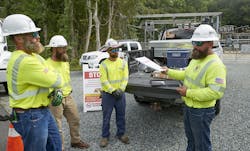
Equally important, the pre-job briefing must be more than a signature. We treat it as a real conversation anchored by the energy wheel. We ask, “Which energies are in play today?” and "What’s changed since yesterday?” These questions help crews speak up without feeling they’re slowing down the job. When our utility crews understand the why—for example, that the arc flash boundary protects you from thermal energy while the restricted approach limit protects you from contact—the what (i.e., barricades and distances) becomes nonnegotiable.
Address safety risks.
One uncomfortable data point: Most workplace electrical fatalities occur in nonelectrical occupations. Fatalities don’t just happen to linemen, technicians and those working around live electrical lines. People who aren’t electrical workers often take risks they don't recognize as electrical. As a result, you need to expand your training and boundary control mindset to everyone who crosses your work zone or could energize your isolation, not just the person with the meter.
The broader statistics reinforce the stakes: About 1,940 electrical fatalities were reported from 2011 to 2023, with an average of 150 electrical fatalities per year, according to the Electrical Safety Foundation. Each number represents a person whose exposure was often preventable by de-energization, boundary control, safety briefings and better coordination efforts.
Focus on what matters.
Open and exposed environments don’t have to mean uncontrollable electrical risk. If you start with energy, prioritize de-energization and apply 70E’s hierarchy with IEEE 1584’s rigor, then you are on a safe path.
Make sure all employees understand the difference between shock and arc flash boundaries, then build a culture that treats Stop Work Authority and Obligation as a professional duty.
With these guidelines and precautions firmly in place, you can produce the only outcomes that matter most: People going home safely and assets operating as designed. That’s the promise we owe to our teams and to the public that often stands just outside our cones.
Read more:
 Electrical Fatalities Remain Same Year-Over-Year
 Understanding and Avoiding Electrocution Risks



About the Author
Richard W. Neill
Richard W. Neill, CSP, CHST, CUSP, is Senior Vice President and Chief Safety, Health, Environmental, and Quality Officer at Centuri Group, Inc., where he leads the development and implementation of safety and quality programs across complex energy-infrastructure projects. He has 30+ years of experience spanning utility electric and gas, petrochemical, biopharma, industrial construction, and offshore wind, with prior leadership roles at Riggs Distler, Matrix NAC, and Jacobs. He holds a B.S. in Occupational Safety & Hygiene Management from Millersville University of Pennsylvania.