Podcast: How to Bring AI into Your Safety Organization
As AI has moved from the pilot stage to the operational stage, companies need to understand both the potential and pitfalls of the technology.
EHS Today talked with Arianna Howard, who is co-founder and managing partner of Syncra Group. She is also the lead of the Standards-Based User Group (SBUG) on AI in Safety for the American Society of Safety Professionals (ASSP).
Howard has helped many companies through digital systems transformation to AI enablement and has learned that companies must focus on the problem first and the technology second.
You can listen to the full podcast by clicking on the player below.

The following is an excerpt from the interview.
EHS Today: How are companies using AI in the safety sector?
Arianna Howard: I think at this point in time, everyone in the safety organization has been exposed to AI in some way, whether they wanted to or not. Most are still trying to figure out where it fits within their workflow -- whether it's on the thought partnership level or whether it's starting to hand off work.
I think where we see the most beneficial and comfortable use case right now is still administrative, so generating reports, incident summaries and toolbox talks.
We're starting to see a big emergence with AI being embedded in tools that we already procure. We are interacting with these AI assistants and agents and are still trying to figure out what's working.
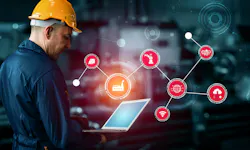
And there is the physical environment: wearables, sensors, cameras, computer vision. AI is integrated not just into the software, but also the hardware. So, everyone's a little spread out on the maturity level.
EHS Today: Which AI applications are reducing safety risks?
Howard: My take on this is that it's not AI reducing risk. It is AI giving us visibility into risk that already existed.
Until the recent emergence of AI, risk data was mostly human-driven. So, risk assessments, incident reporting, observation reporting, the structured forms with question one, two, three, drop-downs that were pre-selected, who knows how many years ago. And you're maybe only capturing- I can't put a number to it, but if I had to guess, maybe 50% of your real risk.
What I think changes with AI are the inputs we can move from structured data in those forms to more unstructured data, such as photos, videos, voice transcripts, computers detecting things 24-7, and being able to record toolbox talks and learn from them. The input calculation has changed a lot, which I think is awesome.
And that doesn't require as much upskilling because it's like, oh, this tool is available, let me use it. I think the corralling of it is where the skill set needs to maybe improve, so taking all of that data and then making sense of it so that you can focus on your capital expenditure and resources.
We know that EHS professionals are burnt out. They're being told to do more with less. You can now take this new information that AI is giving you and inject your expertise and your leadership and strategy and the company's goals and compliance requirements, so you can focus on the 10% that's actually changing.
The environment is changing a lot. Even when you think about robotics working next to humans, those robots have lots of sensors and data on them. Recently, I asked a company that is incorporating that data how that is changing the risk profile of the facility. They didn't quite have an answer yet. That's truly where I think reducing risk is coming from. It's being able to focus on the right resources in the right places and being able to do it more quickly and rapidly with justification.
Showing someone a video of a computer vision capture in their area on their line, both from a training perspective and just a human influence perspective, is going to go a lot further than they can see themselves in the video.
EHS Today: What are the risks when AI systems fail and behave unpredictably, especially in physical settings like warehouses, construction, or manufacturing?
Howard: I find the biggest failures come from lacking context. Systems don't necessarily understand the floor plan. It wasn't trained on that domain. Are we on a construction site? Are we a utilities AI pilot? It's going to look very different than a manufacturing facility or a warehouse that doesn't change that often.
If I put a computer vision camera on line A and today it's a general assembly line, but tomorrow it's the battery line, is the AI now looking for thermal runaway?
And then you have more wearable types of devices. Those come from more of the psychosocial risk. What are we doing with this data? What are we not doing with this data? How are we communicating with our labor relations team and unions?
We need to be able to break down the basic elementary steps of what we're trying to accomplish and then figure out what role AI is playing in those steps and where humans need to intervene.