Beyond the Warehouse Walls: Rethinking Yard Safety
Key Highlights
- Treat the yard as an extension of the workplace, with engineered controls, traffic plans and cross-functional accountability.
- Combine technology, equipment and behavioral improvements to address yard safety rather than relying on visibility or compliance alone.
- Use leading indicators such as near misses, speeding and harsh braking to identify risks before they become incidents.
- Improving yard efficiency can reduce unnecessary moves and congestion while supporting safer, more predictable supply chain operations.
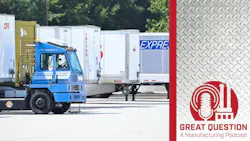




The yard is no longer just the space between transportation and warehousing. It's where safety, execution, and business performance intersect. In this sponsored episode of Great Question: A Manufacturing Podcast, YMX Logistics' Adam Buttgenbach discusses why yard operations are becoming an increasing focus for EHS leaders and how companies can move from reactive risk management to a more coordinated, proactive approach.
Below is the transcript from the podcast:
Nicole Stempak: Today is a special bonus podcast and is sponsored by YMX Logistics. Joining me today is Adam Buttgenbach, vice president of fleet strategy and loss prevention at YMX logistics, where he helps enterprise shippers improve fleet performance, safety and operational performance. He brings more than 20 years of leadership experience in logistics, procurement, maintenance and logistics transformation to YMX. It's a pleasure to have you here today, Adam.
Adam Buttgenbach: Thank you for having me, Nicole.
Stempak: I’d like to break down some of the challenges surrounding yard safety by looking at the current state of affairs, some pitfalls and what the future of yard safety might look like. All right, let’s dive in. Yard operations have traditionally received less attention than transportation or warehouse safety. Do you see that changing? And if so, why?
Buttgenbach: Yes, I think that's a really good point. I think traditionally they have received less attention, for various reasons. I think a lot of large organizations have a lot of competing priorities, whether it’s manufacturing, warehousing, transportation, and a lot of times with limited capital and resources available, they have to make those challenging decisions. But I’m at least optimistic that we will see some change and some improvement when it comes to focusing on the yard.
Things like OSHA’s decision to extend its warehousing and distribution center National Emphasis Program suggests that retailers continue to focus on distribution environments, particularly the yard and in a lot of cases this is where we have vehicle pedestrian interactions. There’s a lot of congestion, there’s a lot of trailer movement around the dock, poor visibility, and other external factors are involved. So we do believe and see that the yard is being treated more as an extension of the workplace, not simply the space between the gate and the facility.
Stempak: You’ve mentioned a couple reasons already, but why are yards uniquely difficult environments to manage safety?
Buttgenbach: That’s a great question. Unlike warehouses, the environment is constantly shifting. We have people making split-second decisions, operating relatively small footprints with a lot of congestion. And a lot of times there’s unplanned external factors that enter the yard. So you might have first time transportation companies coming on site, drivers not knowing where to go or how the traffic flow patterns work. And so because of that, there’s a lot of inconsistent and unplanned-for variables that enter the operation.
Stempak: So having to be constantly focused on efficiency and the normal flow, but then planning for these new variables, does that create additional complexity to the yard?
Buttgenbach: Definitely. I'm thinking about my own experiences with the yard and observations, and it definitely rings true. So that being said, companies are doing things right. They are investing in technology such as visibility tools and additional labor.
Stempak: But why do you think safety challenges persist and how are traditional approaches to improving yard safety falling short?
Buttgenbach: In most traditional approaches, we typically see companies focus on one part of the problem, whether labor providers are focusing on staffing, or whether technology providers are focusing on visibility. We see safety programs that focus on compliance, but not necessarily behavioral changes. So really our approach has been to take a holistic view of the yard entirely, not just individually on those programs. Implementing things like technology might create visibility, but having data and visibility doesn’t automatically lead to safe execution. So we really try to leverage things like our YMX OS system to help improve the efficiency of the yard by mapping where the existing trailers might be, where the existing docks are, but then also leveraging AI and predictive analytics to understand where they might go next. So when we leverage technology with behavioral improvements, with the right equipment, the interconnection of all of these things is what helps create a safer ecosystem that our drivers can operate in.
Stempak: If you were designing a future safety standard for yard operations, what would it include?
Buttgenbach: I think the future standard won’t be built around awareness alone. I think it’ll be built around an engineered set of controls, disciplined execution, measured accountability, where there are defined operating procedures, traffic management plans, engineered pedestrian controls, real-time visibility to equipment on the yard, moves coming down the system, standardized training focused on driver improvements and behavioral changes, and cross-functional accountability between operations, safety, the warehouse and third-party contractors all together.
Stempak: What should EHS leaders be measuring that they might not be? And what might they be missing out on by not doing so?
Buttgenbach: I think a lot of organizations focus heavily on lagging indicators. So a lot of times we look at things like injury rates or incident rates, or days away. And those are great tools to identify where you have risk and where you have problems. But ideally, leading organizations are also looking at where you have near misses, what trends look like, where you’re having speeding or behavioral issues, where you’re having harsh braking, pedestrian zones and potential opportunities for where you might have risk, whether it’s blind backing, whether it’s crosswalks from a parking lot into the warehouse, and then training compliance as you have new operators coming onto the sites. How are you training new employees? How are you measuring that training and then doing follow up as well? The goal is to help identify those risks before someone gets hurt, so we incorporate a lot of the technology as well as those processes into the cab of all of our vehicles. It’s that combined equipment data with driver data, leveraging vision AI solutions inside the cab to help us identify where those risks are and trying to mitigate those before they do become an incident or an accident.
Stempak: I’d like to follow up on something that you just mentioned, talking about those leading indicators. Is there a good way to capture or to quantify them? Not necessarily writing them down, but something to that effect, because I feel like a lot of times, even in our own lives, when there’s a near miss, you just kind of wipe your brow, take a couple seconds to compose yourself, and then get back to it because there’s still things moving, there’s still lots of things going on, and you just have to have to keep going.
Buttgenbach: Yes, absolutely. So there’s a lot of things that we do look at that don’t necessarily show up as an actual incident or an accident. We do try to better leverage technology to help identify where those risks are. So if it is things like drivers taking sharp cornering, leveraging onboard telematics hardware and vehicle data, we’re able to see how the vehicles are moving and interacting and potentially see those trends that could lead to high-risk events leveraging our external facing cameras. We can also see things like drivers, how they approach a stop sign if they're coming to a full stop as they approach via intersections, are they driving through a yellow light instead of coming to a stop early? Getting some of this data through technology like camera systems and vision AI allows us to build a profile of our driver behavior that we can then build customized and tailored training to that individual that helps address their specific habits, rather than just providing generic training across the board.
In addition, when it comes to the yards being uniquely challenging, is unlike the warehouse where you’re operating within the four walls of the facility, when you’re out on the yard, not only do you have all these other variables, but the weather also becomes a variable. You have to be aware of extreme heat stress that could impact drivers if you’re operating in the summertime, in really warm climates, and you have to be aware of potential rain events, lightning strikes if people are operating [equipment]. Or if it’s cold and you’re operating in the middle of the winter in northern climates. So the yard is much more exposed to a lot of these unplanned-for variables that can introduce risk into the operation. So having to account for multiple challenges just adds another layer of complexity when it comes to the yard versus other parts of the supply chain.
Stempak: It sounds like the goal is to improve safety through behavioral changes, and to weed out or discourage or positively reinforce the behaviors you want to see in your workers at an early point before you get to the near miss.
Buttgenbach: That’s correct. When it comes to safety, we do try to focus on a combination of people, processes, technology and equipment, and really look at the intersection of all those things. So when it comes to people, are we giving them the right training? Are we giving them the right PPE and right tools to be successful in their job and going beyond just the standardized training and development, but getting that profile of the driver, using technology and helping build tailored training around safety for that individual to help them operate in a safer environment.
In addition to that, things like cleaning up the operation and making it more efficient. A lot of times, in transportation, when we look at it, the safest move is the one that we don’t have to make. So when we do clean up the yard from inefficiencies, we’re putting our drivers in a better place where they’re operating safer. So operational efficiency using our yard management OS allows us to do that by better integrating with the warehouse with transportation providers and understanding where things are on the yard. And then also when it comes to processes, leveraging traffic flow, leveraging key areas for parking trailers, clear identifying marks, and then training drivers on what that process looks like, and then lastly, making sure that we have the safest equipment out there. So making sure when we do put equipment in the hands of our operators, that they’ve been properly trained on it.
But we also have equipment that helps identify risk, whether it’s with additional lighting, additional mirrors to help see things better, the right tools and technologies to help prevent drop trailers or backing incidents, making sure we have three points of contact and the correct materials on our equipment that help reduce slips, trips and falls also all go into helping protect our employees while they’re on the yard.
Stempak: Switching gears ever so slightly, what is the risk of maintaining the status quo and doing things the way that we’ve always done them? And then kind of on the flip side, what’s the reward for organizations that get this right?
Buttgenbach: That’s a great point. I think there are a lot of risks just staying with the status quo. Obviously, from a safety standpoint, there’s a lot of safety exposure by continuing to do things the way that they are, which number one could lead to injuries and accidents, and then potentially extend into regulatory attention from there. And all of these things lead to operational disruptions and service failures. They can lead to labor challenges with being able to stay staffed and keep people on the yard and ultimately lead to rising costs and inefficiencies in the broader part of organizations’ supply chains.
So I think people are now starting to realize that the yard is a key component of the supply chain, and the importance extends into warehousing, transportation, manufacturing, beyond just the yard itself. And for those companies that are taking a more proactive approach, making the workplace a safer environment with fewer injuries and accidents is a key opportunity and a key benefit, but it can also help with more predictable flow of the yard. It can reduce congestion, it can produce better throughput on the yard. It can improve service levels, improve the overall supply chain network for an organization.
And so I think we’re going to see those rewards really outweigh a lot of what we’ve seen previously with the status quo. The yard should no longer be viewed as a space between transportation and warehousing. It’s really an active operating environment where safety, execution and business performance all intersect. And the companies that design their yard operations around this realize that they’re going to be setting the new standard when it comes to safety and operations.
Sponsored By:

About the Author
 Nicole Stempak
Nicole Stempak
Nicole Stempak is managing editor of EHS Today and conference content manager of the Safety Leadership Conference.