Podcast: How to Stay Cool on the Job as Temperatures Soar
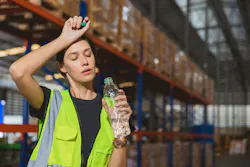
It's a lot more difficult to keep calm and carry on in the summer. In fact, the popular British World War II era slogan should probably be adapted to "Keep calm—and cool and comfortable—in order to carry on."
Summer heat waves and heat domes are serious threats, not something to be brushed aside or ignored.
For several days at the end of June and beginning of July, nearly half (over 160 million) of the U.S. population was under a National Weather Service extreme heat advisory, warning or watch.

“I would consider heat as almost a silent killer, which sounds really morbid, but it can be really problematic because a lot of times when we think about heat, we think only about heat illness, like heat exhaustion and heat stroke,” says Maggie Morrissey, PhD, assistant professor at Providence College and senior occupational heat safety advisor at the Korey Stringer Institute at the University of Connecticut. “But there's so many other secondary injuries that are both acute and chronic.”
The effects of and complications due to heat, including heat stress and heat illness, are not new workplace safety concerns; however, more people are being exposed to extreme heat, both at higher intensity and for longer duration due to a changing climate.
Federal and state Occupational Safety and Health Administration (OSHA) programs are inspecting workplace and issuing citations for unsafe conditions, though the threat of noncompliance isn’t the real threat on days with high humidity or record-breaking temperatures. It’s the risk that people will get hurt, whether because they haven’t acclimated to the heat, feel the heat more severely because of medications or underlying health conditions, engage in risky behaviors due to dehydration or can’t cool down.
As this El Niño season continues to strengthen, it’ll be more important than ever that all workplaces have plans in place—written down, prominently posted and in a language that workers can comprehend—about how to protect workers. From adjusting shifts to cooling stations to cold water to restroom access, there are plenty of policies and personal protective equipment (PPE) that workplaces can provide to make work, be it inside or outside, more bearable and comfortable.
“I think that the most difficult thing is not necessarily the what to do piece,” Morrissey says. “A lot of times, if you ask anyone, they're like, I generally know what to do when it's hot, but it's the how to do it and the feasibility piece.
“There’s no one-size-fits-all approach. I mean, the general topics are the same, but the implementation is what's different. That's the hard piece, the implementation.”
Morrissey spoke with Managing Editor Nicole Stempak about heat safety, heat illness and workplace culture in this latest episode of Great Question: A Manufacturing Podcast. You can hear their full conversation below. Don’t forget to subscribe, so you never miss an episode!
[Editor's Note: This excerpt has been lightly edited for length, grammar and clarity, such as to omit word repetitions, remove incomplete thoughts and punctuate run-on sentences.]
EHS Today: Back in 2022, OSHA, under then Assistant Secretary of Labor for Occupational Safety and Health Doug Parker, issued a National Emphasis Program, which is abbreviated as NEP, for Outdoor and Indoor Heat-related Hazards. That NEP expired on April 8 of this year. Then, two days later, on April 10, OSHA, under David Keeling issued an updated NEP that is active for the next five years. Could you tell listeners, at a broad level, what has changed and what has stayed the same under that NEP?
Maggie Morrissey: This NEP is going to be longer in terms of its expiration date. It's five years.
Probably the biggest change is that rather than having 70 industries, it's focused on 55. It's more targeted to those that we have a better understanding of the level of heat stress that these industries are at higher risk of. And there's just a little bit more information as far as what they're looking for in terms of a citation. And there's more programmed inspections during very high heat periods or days. Those are just some of the major changes to the new NEP.
I'm just wondering what happens to the workers in those 20 or so industries that are no longer included? How do we keep them safe, too?
That's a great question! Unfortunately, I think one thing that people forget is that heat stress or heat strain and heat-related injuries are only in industries that experience a high environmental heat. In reality, if you are performing physical work and generating heat, your body actually can increase your risk of a heat-related injury. So, it has a lot to do with the physical demands of the work, too.
I think maybe some of those industries may not have a lot of environmental heat exposure, but they could be wearing a lot of PPE that could cause heat related injuries as well as just performing a physically demanding job. I think these industries should not think of themselves as exempt from a heat injury or illness, but rather they still could get inspected. They still need to have this heat stress management plan in place.
Definitely. And as a quick story time aside, I was a community reporter years ago. One summer, the editor assigned me a heat story. Construction workers and people who are working outside were obvious sources to talk to. But there's plenty of folks who work inside who feel the heat, too.
Like a pizza shop. They're working with those ovens all day or any food industry. Or dry cleaners. They might have cool air blowing, but because of the work that's being done, they can't feel it. Or they might just be cycling around hot air with other chemicals.
We usually talk about industrial and manufacturing, but there's plenty of other folks who need protection from the heat too, especially ones you might not think of. It's just so much to be mindful of in keeping all workers safe from all kinds of heat environments.
I actually did a qualitative study a few years ago. It was specifically on female workers who work in the heat, but some of the female workers that we interviewed were actually from the restaurant business. They had to take it upon themselves to protect themselves from the heat, because it wasn't a hazard that their employer thought about. Again, because they might not be part of that targeted industry. Others that people don't think about is in the tourism industry, [such as the people in costume at] Disney World.
I think when we're trying to create these heat stress plans, we are often very limited in what's included. Across many different industries, lot of times, these workers are low income and many of them don't speak English as their primary language. And so a lot of the protections that are written down or spoken about they don't necessarily think about, because it's not in a language that is very accessible to them immediately. Even if you do have a heat plan, you have to think about how it's actually getting to the people who are performing the work.
Unfortunately, I think one thing that people forget is that heat stress or heat strain and heat-related injuries are only in industries that experience a high environmental heat. In reality, if you are performing physical work and generating heat, your body actually can increase your risk of a heat-related injury. So, it has a lot to do with the physical demands of the work, too.
Let's talk about what employers are required to do as a baseline and then let's go from there. So according to the NEP, what do employers need to provide for their workers to protect them from the heat?
If they're thinking about citations, unfortunately we have no heat federal regulation right now. And so, everything as far as a citation goes is going to come from the General Duty Clause, which basically says that you have to protect your workers and provide a safe working environment without having known hazards. I think that's important to know that's the type of enforcement when we think about the citations.
As far as specifics go, I think it's also important to recognize that not every state is going to be the same, either. There are some states, like Oregon and California, that do have mandated standards. It’s important if you're in those states or have jobs that go across multiple states to utilize the most comprehensive standard when you're trying to implement things. Some examples of things that should be done is, of course, providing a written heat stress plan, having some sort of plan for heat acclimatization and making sure you're providing sufficient rest.
OSHA has this campaign for water, rest, shade. Still applies the same, right? The only interesting thing is that there's a lot of ambiguity as to what is actually included in these specific things. The term heat acclimatization, as an example, is technically a physiological process where you're getting these adaptations to tolerate heat better. It's really hard for us to do that in the occupational side, because many people aren't actually measuring the physiology of their people. In this context, what exactly would a heat acclimatization protocol be? As far as the specifics of what like OSHA or the NEP would suggest, is a little bit up for interpretation.
There’s a lot to unpack there as far as the compliance threshold, but we like to talk about leading organizations. Let's focus on what employers can do and if you have any ideas for products or things that they can purchase—PPE or otherwise—or just programs that they can implement for how to make work more comfortable in the heat.
I like to start by making sure everyone remembers the foundations. So again, the water, rest, shade. Everything starts from there, but it's important to know that it's only a starting point. I highly recommend having a much more comprehensive outlook. One thing that's not included within that water, rest, shade that I think is considered a foundational component is restroom access. That sounds really interesting for me to say but think about if you don't have access to restrooms, you're not really going to be hydrating well. I like to include that in those foundational components.
On top of that, I like to use the acronym called RESHAPE. It kind of adds another additional layer to OSHA's water, rest, shade. We have rest. We have environmental monitoring, so essentially to make sure that you are reviewing what the wet bulb globe temperature is going to be during the day, but also, you know, in the next couple days. Also, heat acclimatization. Is there some sort of plan to gradually expose somebody to the heat? Hydration, of course. Body cooling and shade is another. [As is written] policies and procedures so people know what to follow.
One thing that I think is really critical and very often forgotten is emergency procedures. So many times, people think about how to stop the heat illness or injury from happening. That's your hydration and your shade. But people need to recognize that not every plan is fail proof. You have to have some sort of method if someone's going to have an exertional heat stroke[, such as] having water and ice and cooling modalities available to aggressively cool somebody to reduce their body temperature.
If I'm working out in the yard and get really hot, I’m taking a break, sitting in air conditioning for a few minutes or having one of those electrolyte powdered drinks. You feel so much better after just that. Or you see people, especially for little kids, walking around with those little fans. It doesn't have to be really expensive or difficult, right? These are things that just offer quality and comfort to the working environment.
Yeah, I think there's a thought that air conditioning is the only solution. And while yes, air conditioning is wonderful and great. If you can work in air conditioning, that's fantastic, but [sometimes] it's not sustainable, and it's not cost effective. As far as cooling the body, there's a lot of different modalities like cooling towels and arm immersion and fans that are low cost that can have extremely effective cooling rates when they're used properly.
It's important to recognize the use of 'properly' because a lot of times, especially with these cooling garments, people put them on and then they don't rewet them. They just leave them on all day, and then they're not doing anything for you. Also, when you're cooling during a rest, I always recommend if you do have some sort of cooling garment or fan, try to cover as much of your body surface area as possible. That's going to cool yourself to a much greater degree than if you're only focusing on like, you know, how there's this myth that you should only focus on the wrists and the back of the neck. Really, you just want to cover as much of your body as possible.
Learn More
 female meteorologist presenting the weather for TV
 Image of multiple computer screens monitoring or tracking the weather with a person in the foreground
 picture of a thermometer in the foreground and clouds and sun in the background
 Getting Ahead of Heat Stress Risks on the Job
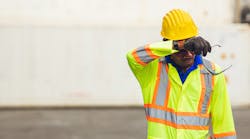 Heat Stress
About the Author
 Nicole Stempak
Nicole Stempak
Nicole Stempak is managing editor of EHS Today and conference content manager of the Safety Leadership Conference.